Nerija "Nettie" Hopkins

The Waggle Dance: How Bees Tell Each Other Exactly Where the Flowers Are

Honeybees can communicate the exact direction and distance of a flower patch, using dance. Here's how the waggle dance works, what it means, and why it won a Nobel Prize.

In 1973, an 86-year-old Austrian zoologist named Karl von Frisch won the Nobel Prize in Physiology or Medicine. He had spent the better part of 50 years watching bees dance.

What he found changed what scientists thought was possible in the animal kingdom. The waggle dance is not metaphor. It is not anthropomorphism. It is a genuine symbolic communication system, where one bee uses movement to convey abstract spatial information to other bees, location, direction, distance, and quality of a food source, all encoded in a figure-eight movement performed in the dark on the surface of a wax comb.

It remains one of the most astonishing things in nature. And most people who eat honey every day have no idea it exists.

What the waggle dance looks like

Picture a figure eight. In the center of the figure, where the two loops cross, the bee runs in a straight line while vibrating her abdomen from side to side. That straight center section is called the waggle run. After completing it, she loops back to one side and runs the straight middle again, then loops back on the other side. The pattern repeats over and over.

Other bees crowd around the dancer. In the dark of the hive, they can't see the dance, they follow it by touch and by the vibrations the dancer's body sends through the comb. They feel the angle, the duration, the intensity.

Then they fly out and find the flowers.

How direction is encoded

Quick answer: The waggle dance is a figure-eight movement honeybee foragers perform inside the hive to communicate the direction and distance of a food source. The angle of the waggle run indicates direction relative to the sun. The duration of the waggle run indicates distance, roughly one second of waggling equals about one kilometer.

The dance happens on a vertical comb surface. Straight up on the comb represents the direction of the sun. If the waggle run points straight up, the food source is directly toward the sun. If it points 30 degrees to the left of straight up, the food source is 30 degrees to the left of the sun's current position.

Bees use the sun as a compass. And they correct for its movement throughout the day. A dance performed at 10 a.m. and a dance describing the same flower patch performed at 2 p.m. will have slightly different angles, because the sun has moved, and the dance accounts for it. Bees know where the sun is, and they know where it will be, without looking at it directly.

This is not a metaphor for cleverness. This is a measurable, documentable spatial calculation performed by an insect with a brain the size of a sesame seed.

How distance is encoded

The longer the waggle run, the farther away the food source is. The relationship is roughly linear: one second of waggling corresponds to approximately one kilometer of distance. A waggle run lasting two seconds points to a food source about two kilometers away.

Bees routinely communicate food sources several kilometers from the hive. The dance scales with the distance.

How quality is communicated

Not all dances are equal. A bee that found a spectacular patch of flowers, rich in nectar, densely blooming, easy to reach, dances more vigorously and for longer than a bee that found something mediocre. The intensity of the dance is a measure of the food source's value.

Other foragers don't follow every dancer blindly. They attend to multiple dancers, comparing the vigor and duration of different dances. Better food sources recruit more followers. It's a distributed decision-making system for resource allocation, running continuously inside the hive on every warm day of the foraging season.

There's also a "stop signal", a brief head-butt that one bee can deliver to a dancer to inhibit the dance and discourage foraging from a particular source. This happens when a scout returns from a site that turned out to be near a threat, like a predator or a pesticide-treated field. The communication works in both directions.

Round dance vs. waggle dance

The waggle dance is used for distances greater than about 80 to 100 meters. For nearby food sources, bees use a simpler round dance, a circular movement that signals "food is close" but doesn't communicate direction. It's less precise because precision matters less at short distances. The waggle dance's directional encoding only becomes necessary when you're sending bees miles away through unfamiliar territory.

What this discovery means

Before von Frisch published his findings, the scientific consensus was that symbolic communication, using abstract signals to represent things not present, was unique to humans. Language, essentially, was a human trait.

Von Frisch's work required a fundamental revision of that belief. The waggle dance is symbolic communication. The bee is not directly showing her hivemates the flower. She is using a conventional, learned code to represent an abstract spatial relationship. The other bees interpret the code and act on the information.

That's not instinct in the simple sense of the word. It's a shared representational system, refined over millions of years of evolution.

Tom Seeley, a biologist at Cornell who has spent decades studying honeybee swarms and decision-making, has written extensively about what bee democracy looks like in practice. His research on how swarms use waggle dances to select nest sites reads, at times, like a model of collective deliberation that humans struggle to match.

What it means standing next to a hive

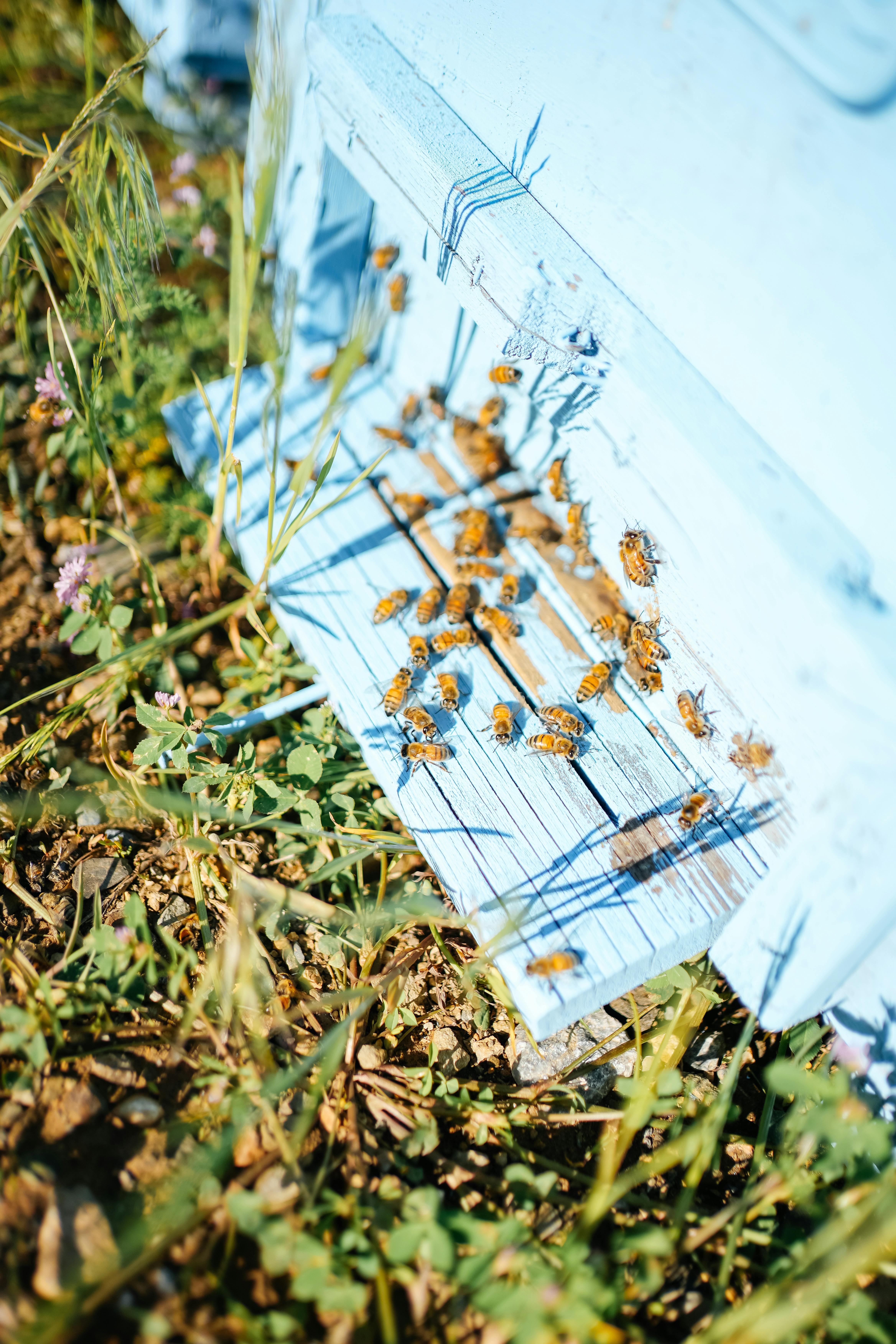
On a summer afternoon, watching bees stream in and out of a hive entrance, it's easy to see the traffic without understanding what's driving it. Every bee returning with loaded pollen baskets went somewhere specific. Every bee leaving right now received directions from a dancer inside, and knows, within a few hundred meters, where she's going and how long it will take to get there.

The honey in a jar represents not just nectar and chemistry. It represents thousands of these communication events accumulated across a foraging season. A bee learned where the goldenrod was blooming. She danced. Others followed. Nectar came back, became honey, got capped in a cell.

Language, in a form we're only beginning to understand, made that jar possible.

Frequently asked questions

What is the waggle dance in bees?

The waggle dance is a figure-eight movement performed by honeybee foragers inside the hive to communicate the location of a food source. The angle of the central waggle run indicates direction relative to the sun, and the duration indicates distance. It is one of the few known examples of symbolic communication in the animal world.

How do bees tell each other where flowers are?

Through the waggle dance. A returning forager performs the dance on the vertical surface of the honeycomb. Other bees gather around to follow the dance by touch and vibration. The angle of the waggle run relative to vertical encodes direction, and the length of the waggle run encodes distance. The intensity of the dance signals how good the food source is.

How accurate is the bee waggle dance?

Quite accurate. Studies tracking bees from hive to flower have confirmed they navigate to within a few hundred meters of the locations communicated by dancers, often in unfamiliar territory. The directional encoding is precise enough that bees adjust the angle of the dance to account for the sun's movement throughout the day.

What is the difference between a waggle dance and a round dance?

The round dance signals that food is nearby (within about 80 to 100 meters) but doesn't communicate direction. The waggle dance is used for more distant food sources and encodes both direction and distance in a figure-eight pattern.

Did Karl von Frisch really win a Nobel Prize for studying bees?

Yes. In 1973, Karl von Frisch shared the Nobel Prize in Physiology or Medicine with Nikolaas Tinbergen and Konrad Lorenz for their work on animal behavior. Von Frisch's specific contribution was his decades of research on bee communication and navigation, including the discovery and interpretation of the waggle dance.

Can all bees waggle dance, or only honeybees?

The waggle dance is specific to honeybees (genus Apis). Other bee species, including bumblebees and solitary bees, do not communicate food locations through dance. Some species of stingless bees (Meliponini) have simpler location-signaling behaviors, but the full waggle dance system is a honeybee trait.