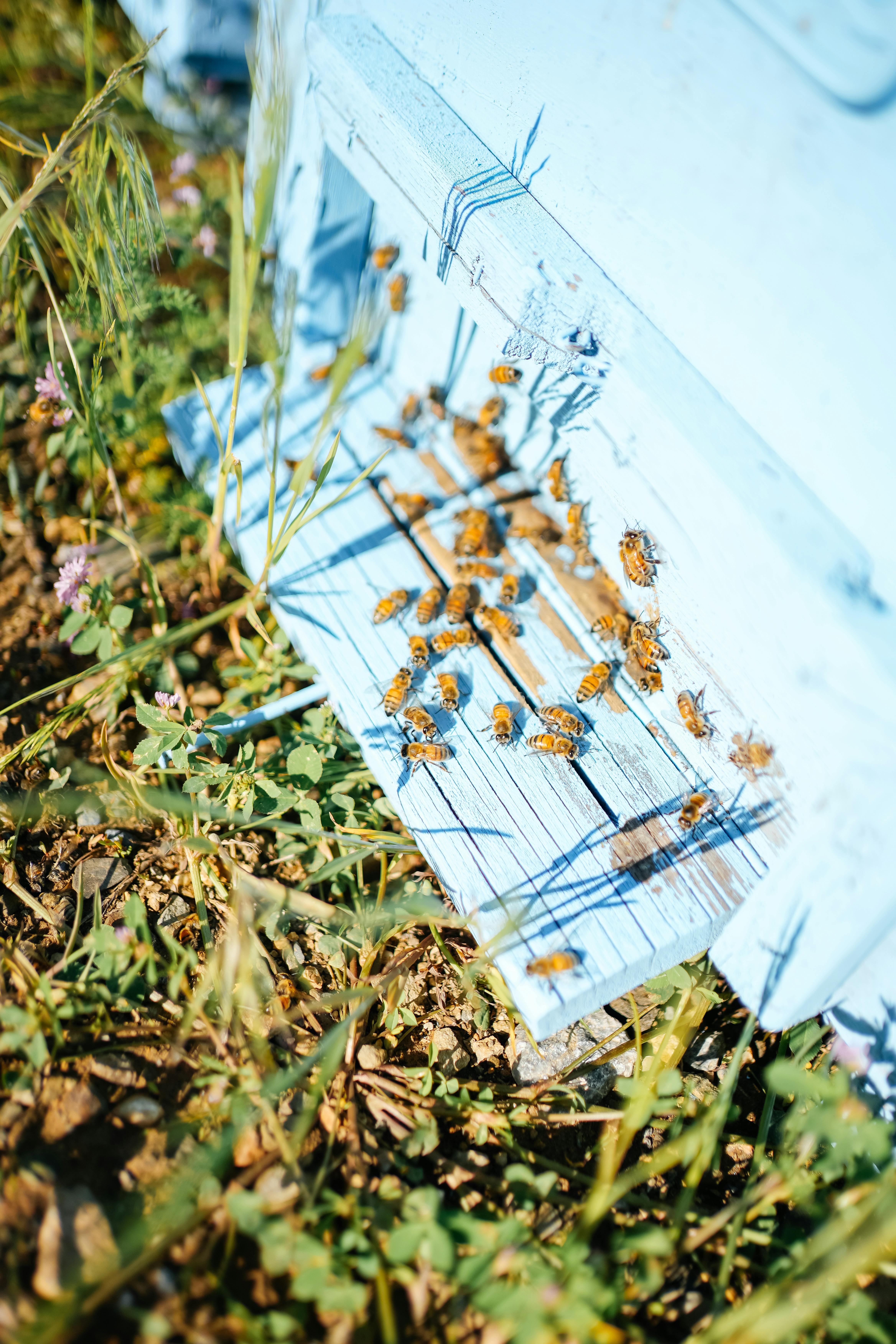
Every single bee in a honeybee colony, worker, drone, queen, starts as an identical egg. An egg the size of a grain of rice, standing upright in a wax cell.
What that egg becomes is determined not by genetics alone but by what it gets fed in its first few days of life. The same fertilized egg that becomes a worker bee could become a queen bee, given different food and a different cell. That's one of the stranger facts in bee biology. The entire social structure of the hive hinges on a feeding decision made before the larva even knows it's alive.
Here's how the full lifecycle works, from egg to adult, and what makes each of the three castes so different from the others.
The four stages every bee goes through
All three castes, worker, drone, and queen, go through the same four developmental stages. The timeline just differs.
Quick answer: A honeybee's lifecycle has four stages: egg, larva, pupa, and adult. Worker bees develop from egg to adult in 21 days, drones in 24 days, and queens in just 16 days. Adult worker bees live 6 weeks in summer and up to 6 months in winter. A queen bee can live 3 to 5 years.
Egg (days 1–3): The queen lays a single egg in each cell. Fertilized eggs become workers or queens; unfertilized eggs become drones. The egg stands upright on day one, tilts on day two, lies flat on day three. When you're inspecting a hive and you can see standing eggs, you know the queen has been there within the past 24 hours.
Larva (days 4–9): The egg hatches into a tiny larva. All larvae receive royal jelly for the first three days, a protein-rich secretion produced by nurse bees. After day three, worker and drone larvae switch to a diet of pollen and honey mixed together (called "bee bread"). Queen larvae continue on royal jelly exclusively. That difference in diet is what determines whether a worker or a queen emerges.
Pupa (days 10 onward, varying by caste): Nurse bees cap the cell with beeswax. Inside, the larva pupates, spinning a cocoon, then transforming. Legs, wings, compound eyes, internal organs all form during this stage. The adult bee chews through the wax cap to emerge.
Adult: Emergence. The bee is pale and fuzzy at first, darkening and hardening over the next day or two.
The three castes: what makes each one different
- Worker bee (female): develops in 21 days; lives 6 weeks in summer, up to 6 months in winter; performs every hive function except laying fertilized eggs
- Drone (male): develops in 24 days; lives about 8 weeks if they survive; sole purpose is mating with virgin queens
- Queen (female): develops in just 16 days; lives 3 to 5 years; lays all eggs and holds the colony together through pheromones
Worker bees: the backbone of the hive
Workers are all female. They make up 95 percent or more of the colony. And they don't have one job, they have a career.
A worker bee's role inside the hive changes as she ages. This progression is known as temporal polyethism, and it's one of the more elegant pieces of biology in the insect world. Roughly speaking, the sequence goes like this:
Days 1–3: Cell cleaning. Newly emerged workers clean and polish the cells where the next round of eggs will be laid.
Days 4–12: Nurse bee. Her hypopharyngeal glands are active and producing royal jelly. She feeds larvae, tends to the queen, and cares for developing brood.
Days 12–18: House duties. She takes on wax production, comb building, nectar processing, pollen packing, and guarding the hive entrance.
Days 18–21 onward: Forager. She begins flying, collecting nectar, pollen, water, and propolis from flowers. A forager bee flies up to five miles from the hive, visits 50 to 100 flowers per trip, and makes as many as 10 trips a day. In her entire lifetime, she produces roughly one-twelfth of a teaspoon of honey.
That last number is the one that changes how people think about a jar of honey. See exactly how that works in our guide to how bees make honey.
The queen: how she's made, what she does
Queens aren't born different. They're made.
When a colony decides to raise a new queen, because the old one is failing, because they're preparing to swarm, or because an emergency requires it, workers select one or more young larvae and construct special queen cells around them. These cells are larger, oriented vertically, and shaped something like a peanut shell. The larva inside gets fed royal jelly exclusively, from beginning to end.
That exclusive royal jelly diet triggers different gene expression. The larva develops ovaries, a longer abdomen, and a stinger she'll actually use (to kill rival queens, not to defend against humans). She develops in 16 days instead of 21.
The first queen to emerge from her cell typically goes and kills the others before they can hatch, stinging through the wax cap. If two emerge simultaneously, they fight until one dies. It's direct. The colony has one queen.
A few days after emerging, the queen goes on her mating flight. She mates with 12 to 20 drones in the air, storing up to 6 million sperm that she'll use for the rest of her life. She never mates again. Back at the hive, she can begin laying within days, and a healthy queen at peak production lays up to 2,000 eggs per day.
She can live 3 to 5 years. Her pheromones hold the colony together. When she's failing, laying erratically, running low on stored sperm, the workers know. They'll begin raising a replacement.
Drones: the least understood bees
Drones are male. They have no stinger, no pollen baskets, no wax glands. They don't forage. They don't build comb. They can't feed themselves inside the hive, they rely on workers to feed them.
Their only biological purpose is mating. In summer, drones gather in "drone congregation areas", specific locations in the air where virgin queens from various colonies come to mate. If a drone succeeds in mating, he dies immediately afterward. If he doesn't succeed, he returns to the hive, eats, and tries again another day.
In fall, when mating season is over and the colony needs to conserve resources for winter, the workers stop feeding the drones. Then they physically drag them out of the hive. The drones are too big to sting, can't collect food, and die of starvation and cold within days.
Harsh, yes. But it makes complete sense from a colony survival standpoint. Drones serve no purpose in winter. Feeding them would waste the honey stores the colony needs to survive until spring.
Why winter bees live so much longer
A summer worker bee lives about six weeks. A winter bee can live six months. That difference isn't just circumstantial, it's physiological.
Winter bees, raised in late summer and fall, store significantly more fat in their bodies, particularly in structures called fat bodies in the abdomen. These fat stores provide energy during the long months without forage and support the colony's immune function. Winter bees are less metabolically active, better insulated, and built for waiting rather than working at full speed.
When spring comes and foraging begins in earnest, those long-lived winter bees die off rapidly. They've done their job. The colony has survived, and the new summer workforce takes over.
What this means when you open a hive
Every frame inspection tells a story through the lens of these life stages. Standing eggs mean a healthy, recently active queen. Capped brood in a solid pattern means she's laying well. An absence of young brood in spring could mean the queen has died. Seeing drone cells means the colony is thinking about the season ahead.
Learning to read a frame is learning to read time itself, which stages are present, which are missing, and what the colony has been doing for the past 24 hours, the past week, the past month.
It never gets old.
Frequently asked questions
How long does a honeybee live?
It depends on the caste. Worker bees in summer live about 6 weeks from emergence. Winter worker bees can live up to 6 months. Drones live roughly 8 weeks if they survive that long. A queen bee can live 3 to 5 years under normal conditions. Learn more about what bees do in winter and how these different lifespans play out across the seasons.
How long does it take for a bee egg to hatch?
A bee egg hatches into a larva on day 3. From egg to emerged adult, the total development time is 21 days for workers, 24 days for drones, and 16 days for queens.
What is the difference between a worker bee, drone, and queen?
Worker bees are sterile females who perform all the work of the colony, foraging, building comb, feeding brood, guarding. Drones are males whose only purpose is mating with virgin queens. The queen is the only fully fertile female, responsible for laying all the eggs that sustain the colony.
How does a queen bee develop differently from a worker bee?
Queen larvae are fed royal jelly exclusively throughout their development, while worker larvae switch to a diet of pollen and honey after the first three days. The sustained royal jelly diet triggers different gene expression, giving the queen fully developed ovaries, a longer body, and a 16-day development time instead of 21.
What do drone bees do?
Drones exist to mate with virgin queens from other colonies. They contribute nothing to foraging, building, or hive defense. In fall, when their mating purpose is finished for the season, workers evict them from the hive. They die shortly after.
Do worker bees know they're going to die?
Not in any conscious sense. But aging workers do show behavioral changes that suggest their bodies know their phase of life. Older forager bees with worn wings will sometimes stop returning to the hive on their own. The colony has no mourning period, the work continues without them.


.jpg)
.jpg)