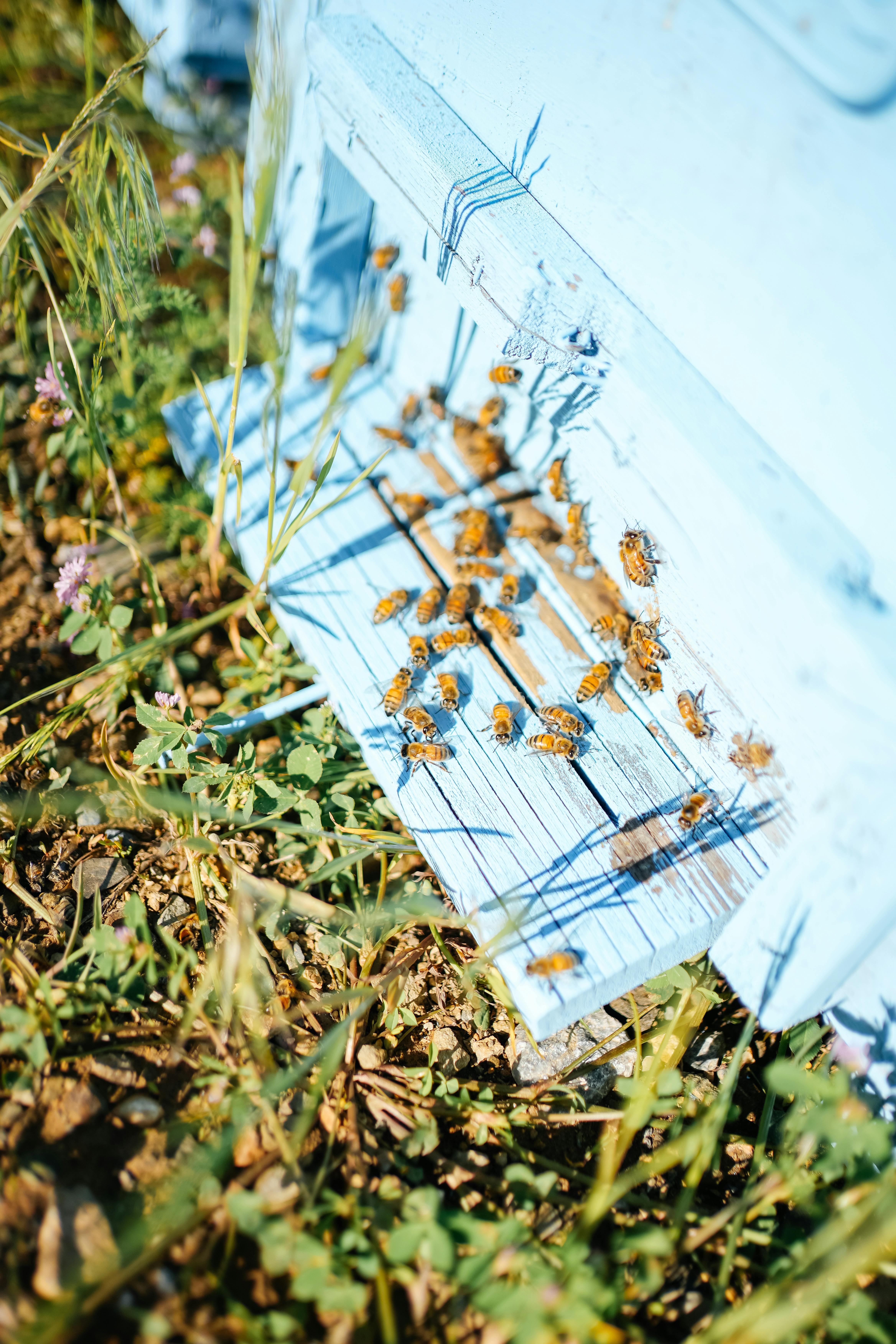
The word "queen" sets you up to picture something wrong. A bee issuing commands from the center of the hive, her subjects buzzing around in obedience. Royalty with authority.
The truth is stranger than that, and in a lot of ways more interesting. The queen bee doesn't rule. She serves. And she does it almost without stopping, from spring's first warm days through the long stretch of summer, day after day.
Here's what her life actually looks like.
Quick answer: The queen bee spends most of her time laying eggs, up to 1,500 to 2,000 per day at peak season, and producing the pheromones that regulate the colony's behavior. She doesn't give orders or make decisions for the hive. Her chemical signals suppress other bees' reproductive instincts, signal her health and presence to the colony, and attract the attendant workers who feed and groom her around the clock. Without a laying queen, a colony begins to fall apart within days.
What does the queen bee actually do all day?
The short answer: she walks from cell to cell and lays eggs. Methodically, continuously, for most of a long active day.
A healthy queen at peak production lays between 1,500 and 2,000 eggs per day. That works out to roughly one egg every 45 seconds, sustained across an active period that can stretch 12 hours or more during summer. She doesn't forage, build comb, guard the entrance, or collect pollen. She doesn't make decisions about where the swarm goes or when to increase drone production. All of that belongs to the workers. Her life is concentrated into two things: laying eggs and producing pheromones.
She is never alone while doing any of this. Wherever the queen moves across the comb, a retinue of 8 to 12 attendant workers follows her, feeding her, grooming her, and removing her waste. This tight entourage is part of how her chemical signals spread through the hive. The attendants absorb her pheromones through physical contact, then disperse through the colony, passing those signals along through touch and food sharing.
On a hive inspection, you can often find the queen just by watching for this cluster. Workers near her orient differently. They face toward her. The behavior is unmistakable once you know what to look for.
How does the queen decide which eggs to lay?
Before laying in each cell, the queen pauses briefly and measures the opening with her front legs. The diameter of the cell tells her what to do next.
Standard-sized cells get fertilized eggs, which develop into female workers. Larger cells, constructed intentionally by workers to raise drones, get unfertilized eggs, which develop into male bees. The queen controls fertilization at the exact moment of laying, releasing sperm from her spermatheca for fertilized eggs, or withholding it for drone eggs.
The spermatheca is a small internal storage organ, and it holds the total sperm supply the queen collected during her mating flights early in her life. A well-mated queen stores between 5 and 7 million sperm. She mated with 12 to 20 different drones, drawing from a range of genetic contributors. She will never mate again. Everything she lays for the next three to five years comes from that stored supply.
This genetic diversity matters more than it might seem. Queens that mated with more drones produce colonies with higher genetic variation among workers, which research has linked to better disease resistance and more stable colony behavior. A 2004 study published in the journal Proceedings of the Royal Society B by David Tarpy and Thomas Seeley found that colonies headed by more highly mated queens were significantly more resistant to disease than those with less genetically diverse queens.
Understanding how all three castes develop from that single laying process is worth a closer look. The complete lifecycle of a honeybee covers how egg, diet, and cell type shape who emerges.
How do queen bee pheromones actually run the hive?
The queen doesn't give orders. She produces chemicals that regulate behavior at a physiological level. This distinction matters.
Her primary signal is called queen mandibular pheromone, or QMP, a blend of roughly 30 compounds produced in glands near her mandibles. In 1988, chemist Keith Slessor and biologist Mark Winston published research in the journal Nature identifying five key compounds in QMP and demonstrating how each influenced different colony behaviors. The most abundant of these, a compound called 9-ODA (9-oxo-2-decenoic acid), does several things at once:
- Suppresses worker bees' ovary development, keeping them sterile as long as a healthy queen is present
- Inhibits workers from building new queen cells under normal conditions
- Attracts drones during mating flights
- Signals to the colony that the queen is alive, present, and functional
The queen also leaves chemical traces from glands on the pads of her feet as she walks across the comb. Workers can detect whether she has moved through a particular area recently. As those traces fade, the colony senses her absence even before they've directly noticed she's gone.
This pheromone network moves fast. In a colony of 40,000 to 60,000 bees, chemical information can circulate through the entire hive within a matter of hours, largely through trophallaxis, the food-sharing behavior where bees pass liquid from mouth to mouth. The queen's attendants are the first link in that chain. They pick up her signals, move through the hive, and the information spreads outward.
Who takes care of the queen?
The queen doesn't feed herself. Her attendant workers produce a rich food called royal jelly, a protein-rich secretion from glands behind their heads, and deliver it directly to her. She also doesn't groom herself. The attendants handle that too, and they remove her waste, a job that sounds unglamorous but is functionally important for keeping her clean and her pheromone signals uncontaminated.
The attendants rotate in and out of the retinue every few hours, which means fresh workers are constantly absorbing her pheromones and carrying them back into the broader colony. The queen is, in a sense, the center of a continuous chemical broadcast, and her attendants are the relay network.
When pheromone levels are strong and consistent, the colony is calm and coordinated. When they weaken, because the queen is aging or sick, the colony notices. And it responds.
How does a queen bee become queen in the first place?
Queens aren't born different. They're made.
The same fertilized egg that becomes a worker bee can become a queen, given a different cell and a different diet. When a colony needs to raise a new queen, because the current one is aging, failing, or the colony is preparing to swarm, workers select one or more young larvae, ideally under three days old, and construct special queen cells around them. These cells are larger than normal worker cells, vertically oriented, and shaped roughly like a peanut shell hanging from the face of the comb.
The larva inside gets fed royal jelly exclusively, from first day through emergence. Worker larvae switch to a diet of pollen and honey after their first three days. That sustained royal jelly diet triggers different gene expression, giving the queen fully developed ovaries, a longer abdomen, and a 16-day development time instead of the worker's 21.
The first queen to emerge typically moves through the comb seeking out the other queen cells and kills the developing queens inside, stinging through the wax caps before they can hatch. If two queens emerge at the same time, they fight until one dies. A hive with two queens is an unstable situation. It resolves quickly.
Within her first one to two weeks, the new queen takes her mating flights on warm, clear afternoons, seeking out the aerial congregation areas where drones from multiple colonies gather. She mates in flight, returns to the hive, and begins laying within days. After that, she rarely leaves again, except at the head of a swarm.
If you ever find a swarm in your yard or on your property in South Coast Massachusetts, we offer honeybee swarm retrieval and can help relocate them safely.
When does a colony decide to replace its queen?
The colony monitors the queen's output and pheromone strength continuously. As she ages, her laying rate drops and her chemical signals weaken. Workers notice both changes. When they do, they begin raising a replacement in a process called supersedure.
Supersedure is different from swarming. In supersedure, the colony quietly raises a new queen while the old one is still present. The old queen and the new queen sometimes coexist briefly. Once the new queen mates and begins laying consistently, the old queen disappears, usually killed by workers or by the new queen herself. The transition is managed, not chaotic.
Swarming is different. When a colony swarms, it's because the hive is strong and crowded, not because the queen is failing. The old queen leaves with roughly half the workers to establish a new colony elsewhere. A virgin queen remains behind to take over the original hive. Swarming is reproduction at the colony level. It's a sign of health, not crisis.
Both processes, supersedure and swarming, fit into the larger rhythm of the colony's year. How the hive manages energy and resources changes dramatically by season. The winter months tell a different story about what bees are capable of: what bees do in winter covers how the colony survives months without forage, with the queen at the center of the cluster the whole time.
Frequently asked questions
How many eggs does a queen bee lay per day?
A healthy queen at peak production lays between 1,500 and 2,000 eggs per day during the height of summer. At roughly one egg every 45 seconds across a 12-plus hour active period, it's one of the most sustained biological outputs in the insect world. In early spring and again in fall, the rate drops considerably as colony population adjusts to the season and available forage.
Does the queen bee actually rule the hive?
No, and this is probably the most widespread misconception about bees. The queen doesn't make decisions for the colony. Collective behavior in the hive emerges from thousands of individual workers responding to environmental cues, pheromone signals, and each other. The waggle dance, the timing of swarms, the decision to raise a new queen, all of these are collective processes. The queen's role is biological, not political: she lays eggs and produces the chemical signals that keep the colony in a stable, functioning state.
How long does a queen bee live?
Queen bees typically live 3 to 5 years. Worker bees in summer live about 6 weeks, and winter worker bees can live up to 6 months. The queen's extended lifespan comes from a combination of factors: continuous royal jelly feeding throughout her life, lower physical stress compared to foragers, and the attentive care of her retinue. Commercial beekeepers often replace queens after 1 to 2 years to maintain peak laying performance, though a naturally managed colony will often wait longer.
What happens when a queen bee dies unexpectedly?
The colony has a narrow window to respond. Workers can only raise a new queen from larvae under about three days old. If young enough larvae are present, they'll begin constructing queen cells immediately. If no suitable larvae exist, the colony becomes permanently queenless. Workers may eventually begin laying unfertilized eggs, since workers have vestigial ovaries, but those eggs can only produce drones. A queenless colony on that path will collapse within a few weeks.
Can a hive have two queens at once?
Rarely, and usually not for long. During supersedure, a new queen and the old queen may coexist briefly while the transition is underway. Some colonies do maintain two queens for a short period in this way. It's not a stable arrangement. Once the new queen is mated and laying, one queen is usually gone within days.
What is queen bee pheromone and what does it do?
Queen mandibular pheromone (QMP) is the primary chemical signal produced by the queen. It suppresses worker ovary development, inhibits workers from raising replacement queens under normal conditions, and tells the colony the queen is healthy and present. It also attracts drones during mating flights. The pheromone spreads through the colony via the attendant workers who physically contact the queen, then circulate through the hive passing the signal along. When pheromone strength drops as a queen ages, the colony begins preparing for her replacement.
The queen bee's life isn't a life of power. It's a life of output. Hour after hour, she moves across the comb, lays, moves on. The colony she sustains carries all of that forward into the honey that ends up in a jar. There's a reason a single good jar makes you think differently about where it came from. How bees make honey takes that thread further, from the egg the queen lays to the capped cell that eventually becomes what you taste.

.jpg)
.jpg)