Ticks on the South Coast: Tick Season, Prevention and Natural Repellents
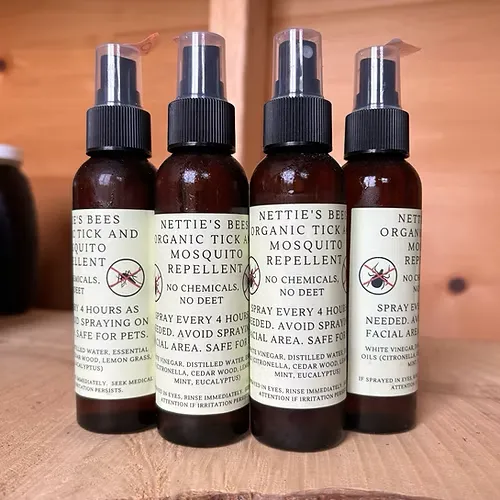
If you spend time outdoors on the South Coast, you know ticks. Beekeepers know them better than most: our hives sit in tall grass at the edges of bogs, fields and woods, which is prime tick habitat. Nettie made her own tick spray after years of working around the cranberry bogs. Here’s what we’ve learned, along with what the health agencies recommend.
Quick answer: In southeastern Massachusetts, ticks are active whenever the temperature is above freezing, with the highest risk from May through July, when tiny nymph deer ticks are out, and again in October and November for adults. Deer ticks can carry Lyme disease, anaplasmosis and babesiosis. Prevent bites with tick checks, a shower after being outside, light clothing tucked in, permethrin-treated gear and a repellent. The CDC recommends EPA-registered repellents; plant-based repellents can help but usually need reapplying more often.
Which ticks live on the South Coast?
- Blacklegged (deer) tick (Ixodes scapularis). The main concern. It carries the germs that cause Lyme disease, anaplasmosis, babesiosis and Powassan virus. Nymphs are the size of a poppy seed and easy to miss.
- American dog tick. Larger, with white markings. It can carry Rocky Mountain spotted fever and tularemia, though these are rare here.
- Lone star tick. Has spread into southeastern Massachusetts, including Cape Cod and the islands. Its bite has been linked to alpha-gal syndrome, an allergy to red meat.
Massachusetts consistently has some of the highest rates of Lyme disease in the country, and the counties of southeastern Massachusetts are among the hardest hit.
When is tick season in Massachusetts?
Ticks don’t truly go away. The Massachusetts Department of Public Health notes that deer ticks can be active any time the temperature is above freezing.
| Season | What’s active | Risk |
|---|---|---|
| Spring (April to June) | Adults finish up; nymphs emerge | Rising, then high |
| Early summer (June to July) | Nymphs at peak | Highest; most Lyme infections happen now |
| Late summer (August to September) | Fewer nymphs; larvae | Moderate |
| Fall (October to November) | Adult deer ticks | High again |
| Winter | Adults on warm days | Low but not zero |
How do you prevent tick bites?
- Know where ticks wait. Tall grass, brush, leaf litter and the edges where lawn meets woods. Walk in the center of trails.
- Dress for it. Light-colored long pants tucked into socks, and long sleeves, make ticks easier to see and harder to reach skin.
- Treat clothing and gear with permethrin. It kills ticks on contact and lasts through several washes. Never apply it to skin.
- Use a repellent on exposed skin. The CDC recommends EPA-registered repellents containing DEET, picaridin, IR3535, oil of lemon eucalyptus (OLE), para-menthane-diol (PMD) or 2-undecanone.
- Do a full tick check after being outdoors: behind knees, around the waist, under arms, in and around ears and hair. Check kids and pets too.
- Shower within two hours of coming inside.
- Put clothes in the dryer on high heat for 10 minutes to kill any ticks hitching a ride.
Do natural tick repellents work?
Some plant oils, including geraniol, cedarwood, rosemary, lemongrass and peppermint, repel ticks in lab tests. Products based on them are usually sold as “minimum risk” pesticides that the EPA doesn’t evaluate for effectiveness. In practice, natural repellents tend to work for a shorter time than DEET or picaridin, so reapply often, especially if you’re sweating.
Oil of lemon eucalyptus is the exception: it’s plant-derived and EPA-registered, but shouldn’t be used on children under 3.
Nettie’s tick spray is her own plant-based, DEET-free blend of essential oils and herbal extracts, developed after years working on the bogs, for gardening and everyday outdoor time. For high-risk situations, like long days in deep brush during peak nymph season, the CDC’s advice is to use an EPA-registered repellent, and permethrin-treated clothing either way.
A note for pet owners: some essential oils can be toxic to cats. Check with your vet before using any essential oil product on or around animals.
How do you remove a tick?
- Use fine-tipped tweezers to grasp the tick as close to the skin as possible.
- Pull upward with steady, even pressure. Don’t twist or jerk.
- Clean the bite and your hands with rubbing alcohol or soap and water.
- Don’t use petroleum jelly, nail polish or heat to make the tick let go; they delay removal.
- Note the date. Watch for a rash or fever over the next month.
A deer tick usually needs to be attached for 36 to 48 hours or more to pass on Lyme disease, which is why daily checks work so well.
When should you see a doctor after a tick bite?
Call your doctor if, within a month of a bite, you develop an expanding red rash (often, but not always, a bull’s-eye), fever, chills, fatigue, headache, or muscle and joint aches. Early treatment for Lyme disease works well.
Frequently asked questions
When are ticks worst in Massachusetts?
From May through July, when nymph deer ticks are most active and hardest to see, and again in October and November for adults.
Do ticks die in winter?
No. Deer ticks survive winter and become active on any day above freezing. Snow cover protects them.
What tick repellent is safest for kids?
The CDC says products with DEET (up to 30%), picaridin and IR3535 can be used on children, following label directions. Don’t use oil of lemon eucalyptus or PMD on children under 3. Ask your pediatrician.
Is natural tick spray as good as DEET?
Usually not as long-lasting. Plant-based sprays can repel ticks but generally need reapplying more often. For long, high-risk exposure, use an EPA-registered repellent and permethrin-treated clothes.
How do I keep ticks out of my yard?
Keep grass mowed, clear leaf litter and brush at the edges, and put a 3-foot strip of wood chips or gravel between lawn and woods.
Sources
- Centers for Disease Control and Prevention, preventing tick bites and tick removal guidance.
- Massachusetts Department of Public Health, tick-borne disease prevention.
- U.S. Environmental Protection Agency, find the repellent that’s right for you.
- UMass Amherst Laboratory of Medical Zoology, TickReport.
These statements have not been evaluated by the Food and Drug Administration. This product is not intended to diagnose, treat, cure, or prevent any disease.
Ticks are part of life here, but they don’t have to keep you indoors. Check yourself every evening, and enjoy the bogs and woods anyway.