Beeswax vs Soy vs Paraffin Candles: What Actually Differs
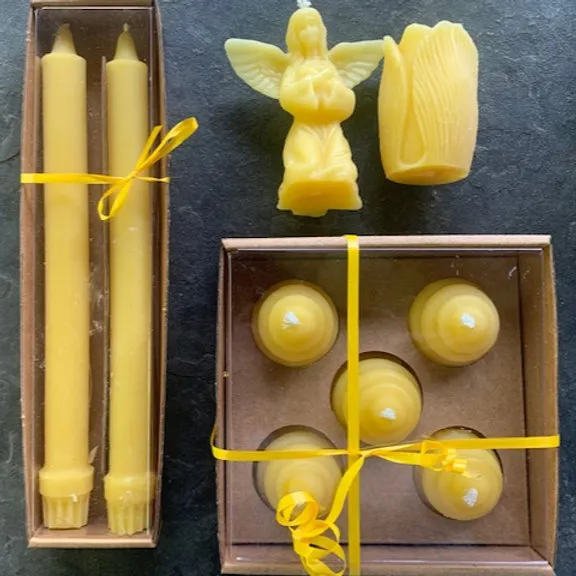
Light a beeswax candle in a dark room and you’ll notice two things: the flame is warm and bright, a little golden, and there’s a faint smell of honey even before the wax melts. People have burned beeswax for light since ancient times. Today it shares the shelf with paraffin and soy, and the three are more different than they look.
Quick answer: Beeswax candles are made from wax produced by honeybees; paraffin from petroleum; and soy wax from hydrogenated soybean oil. Beeswax has the highest melting point, about 144-147°F, so it burns slower and longer, with a bright flame and a natural honey scent. Paraffin is cheapest and holds added fragrance well. Soy is plant-based and burns cooler but softer. Any candle can smoke if its wick is too long, so trimming matters as much as the wax.
Beeswax vs soy vs paraffin at a glance
| Beeswax | Soy wax | Paraffin | |
|---|---|---|---|
| Source | Made by honeybees | Hydrogenated soybean oil | Petroleum refining byproduct |
| Melting point | About 144-147°F (62-64°C) | About 120-130°F (49-54°C) | About 115-150°F (46-66°C), varies by grade |
| Burn | Slow, long, bright flame | Slower than paraffin, softer | Fastest, depending on blend |
| Scent | Natural light honey scent | Neutral; holds added fragrance | Neutral; holds added fragrance best |
| Renewable | Yes | Yes | No |
| Cost | Highest | Moderate | Lowest |
| Appearance | Golden; may develop a white “bloom” | Creamy white, often matte | White, smooth |
Why do beeswax candles burn longer?
Beeswax is the hardest and densest of the three, with the highest melting point. A harder wax melts more slowly, so the same size candle lasts longer. That’s why beeswax tapers and pillars are prized for long dinners and churches have used them for centuries.
Do beeswax candles burn cleaner?
Beeswax burns with very little visible smoke when the wick is trimmed and the candle is out of drafts. But soot depends heavily on wick size, drafts and added fragrances or dyes, so a well-made candle of any wax burns cleaner than a poorly made one.
You’ll often read that beeswax candles release negative ions that clean the air. We haven’t found good scientific evidence for that, so we don’t lean on it. What we can say is that a pure beeswax candle has nothing added: no synthetic fragrance, no dyes, just wax and a cotton wick.
What is the white film on my beeswax candle?
That’s called bloom. It’s a natural haze that forms on pure beeswax as some of its compounds rise to the surface, especially in cool rooms. It’s a sign of real beeswax. Wipe it off with a soft cloth or warm it with a hairdryer and it disappears.
Is soy wax a good alternative?
Soy wax is renewable and burns more slowly than paraffin, which is why it became popular. It’s softer, though, so it’s mostly used in container candles. Many “soy” candles are actually soy blended with paraffin or other waxes; check the label if it matters to you.
How do you care for a beeswax candle?
- Trim the wick to about 1/4 inch before every lighting.
- Burn container and pillar candles long enough the first time for the melted pool to reach the edges, to prevent tunneling.
- Keep it out of drafts, which cause dripping and smoke.
- Burn no more than about four hours at a time, and never leave a candle unattended.
- Store in a cool, dark place. Bloom is normal and harmless.
Frequently asked questions
How can you tell if a candle is real beeswax?
Pure beeswax is golden (unless filtered white), smells faintly of honey, feels harder than paraffin or soy, and often develops a white bloom. Labels that say “beeswax blend” may contain only a little beeswax.
Are beeswax candles worth the price?
They cost more because bees use a great deal of honey to make wax. You get a longer burn, a bright flame and a natural scent. For many people, that’s worth it.
Do beeswax candles smell like honey?
Lightly. Unscented beeswax has a soft, sweet, honey-like smell, strongest from fresh, unfiltered wax.
Can beeswax candles be scented?
They can, but beeswax doesn’t throw added fragrance as strongly as paraffin or soy, and many people prefer its natural scent.
Where does the beeswax for candles come from?
From honeycomb, mostly the wax cappings beekeepers slice off when they harvest honey. Ours comes from our own hives. Read how bees make beeswax.
Sources
- National Candle Association, candle wax and safety guidance.
- Bogdanov S. Beeswax: Production, Properties, Composition, Control. Bee Product Science, 2016.
A beeswax candle is a little piece of the hive in your home. Trim the wick, light it at dinner, and enjoy the glow.