How Do Bees Make Beeswax?
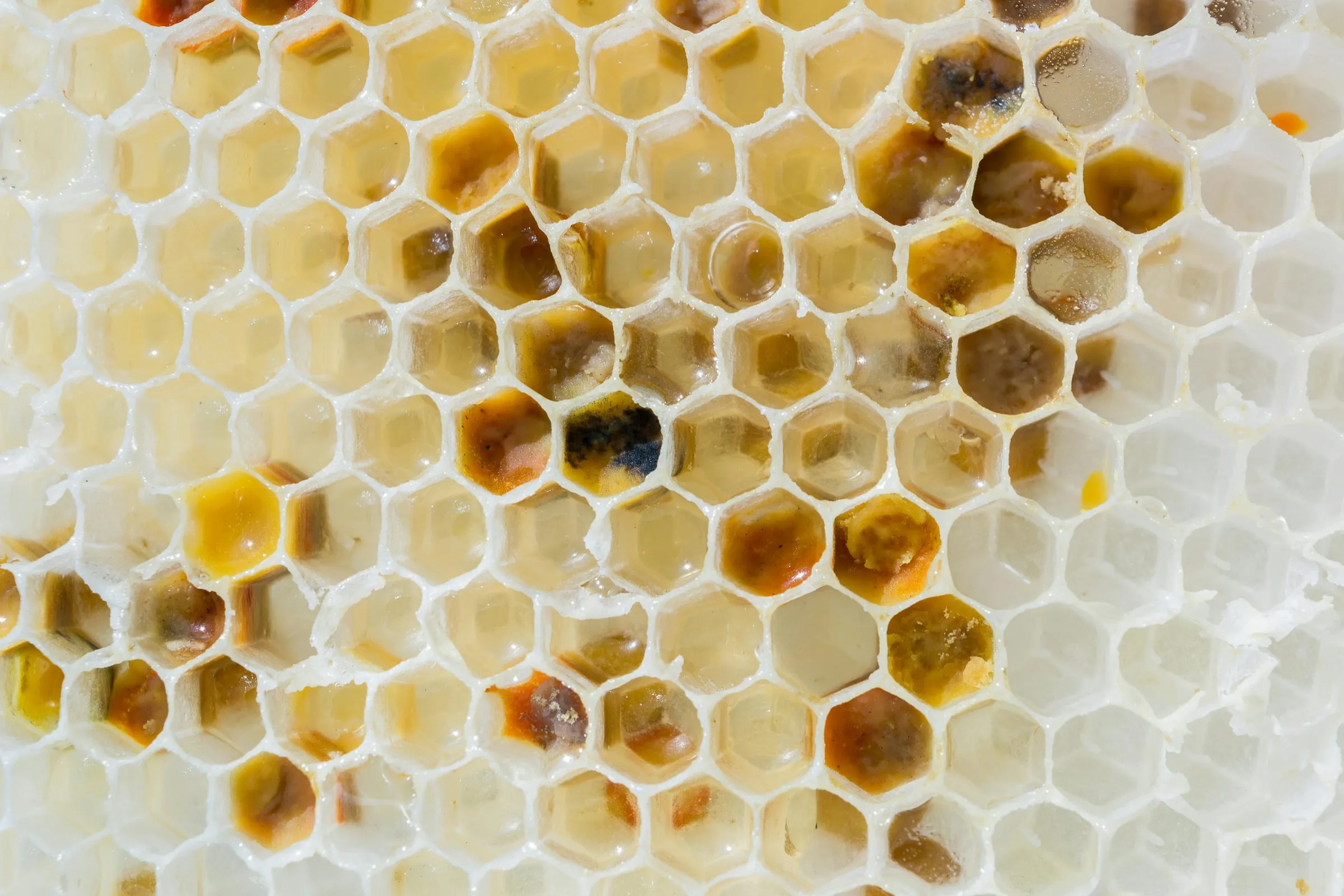
Beeswax doesn’t come from flowers. Bees make it themselves, inside their own bodies, a few tiny flakes at a time. Every honeycomb in a hive, every beeswax candle and every lip balm starts with young worker bees hanging together in chains, turning sugar into wax.
Quick answer: Worker bees make beeswax in four pairs of wax glands on the underside of their abdomen. The glands are most active when bees are about 12 to 18 days old. The bees eat honey, convert its sugar into wax, and secrete it as thin, clear flakes, which they chew and shape with their mandibles into six-sided cells. Making wax takes a lot of honey, often estimated at around 6 to 8 pounds of honey for each pound of wax.
Where do bees make wax?
On the underside of a worker bee’s abdomen are overlapping plates, and beneath four pairs of them sit the wax glands. When a bee is making wax, small, clear, nearly weightless flakes (wax scales) appear between those plates, each one smaller than a grain of rice.
Only worker bees make wax, and mostly at a certain age. Young workers, roughly 12 to 18 days old, have the most active wax glands. That’s the stage between nursing larvae and foraging outside. Older bees’ wax glands shrink, though they can become active again if the colony urgently needs comb, as after a swarm moves into an empty cavity.
How do bees turn sugar into wax?
Wax building is expensive. Bees that are making wax eat a lot of honey or nectar and cluster together, keeping their bodies warm, around 91 to 97°F (33 to 36°C). Their bodies convert the sugar into the fats and esters that make up wax.
Beekeepers often say bees use about 6 to 8 pounds of honey to make a pound of wax. Estimates vary widely depending on how they’re measured, but every estimate agrees on one thing: wax is costly. That’s why beekeepers return empty comb to the hive after extracting honey, so the bees can refill it instead of rebuilding.
How do bees build honeycomb?
Comb builders hang in chains and curtains from the top of the hive, linked leg to leg, a behavior called festooning. A bee pulls a wax flake from her abdomen with her hind legs, passes it forward to her mouth, chews it with saliva until it’s soft and workable, and presses it onto the growing comb. Thousands of bees doing this at once build comb downward from the top.
Bees build several kinds of cells:
- Worker cells, about 5.2 to 5.4 mm across, for raising workers and storing honey and pollen.
- Drone cells, larger, about 6.2 to 6.4 mm, for raising males.
- Queen cells, big peanut-shaped cups that hang down, built only when the colony needs a new queen.
Why is honeycomb hexagonal?
Because hexagons are the most efficient shape. Of all the shapes that tile a flat surface with no gaps, the hexagon encloses the most space with the least wall. Thinkers since ancient Greece suspected this; mathematician Thomas Hales proved it in 1999. For bees, it means the most storage for the least wax.
Bees don’t start with perfect hexagons, though. They build roughly round cells, and the warm, soft wax pulls into hexagons as neighboring cells press together and are shaped by the workers.
What color is beeswax?
New wax is white, almost translucent. It turns yellow and gold from pollen, propolis and honey, and old brood comb gets dark brown from cocoons left behind by generations of young bees. The wax beekeepers prize most is cappings wax, the fresh white-to-gold wax bees use to seal honey cells, which is sliced off at harvest.
What is beeswax used for?
People have used beeswax for thousands of years: for candles, sealing documents, waterproofing, lost-wax metal casting, cosmetics and medicine. Today it goes into:
- Candles. See beeswax vs soy vs paraffin candles.
- Lip balms and skin salves. See beeswax for lips and skin.
- Food wraps, furniture polish and wood finishes.
- Food coatings, where it’s approved as a safe ingredient.
Frequently asked questions
Do all bees make wax?
Only honeybee workers make wax in quantity. Bumblebees make small amounts of wax for their nests; most native bees don’t make wax at all.
Can you eat beeswax?
Yes. It’s safe and passes through you undigested. That’s how people eat honeycomb. See can you eat honeycomb.
How much wax does a hive produce?
A beekeeper typically harvests only about 1 to 2 pounds of cappings wax for every 100 pounds of honey extracted, which shows how little wax there is compared with honey.
Why do beekeepers use wax foundation?
Foundation is a thin sheet of beeswax pressed with a hexagon pattern. It gives bees a head start and keeps comb straight in removable frames, saving them wax and honey.
Does beeswax go bad?
No. Pure beeswax keeps for many years. It may develop a white bloom on the surface, which is natural and harmless.
Sources
- Hepburn HR. Honeybees and Wax: An Experimental Natural History. Springer, 1986.
- Hales TC. “The honeycomb conjecture.” Discrete & Computational Geometry, 2001.
- Winston ML. The Biology of the Honey Bee. Harvard University Press, 1987.
Next time you light a beeswax candle or open a jar of honey, think of the young bees hanging in chains in the dark, turning sugar into wax one tiny flake at a time.