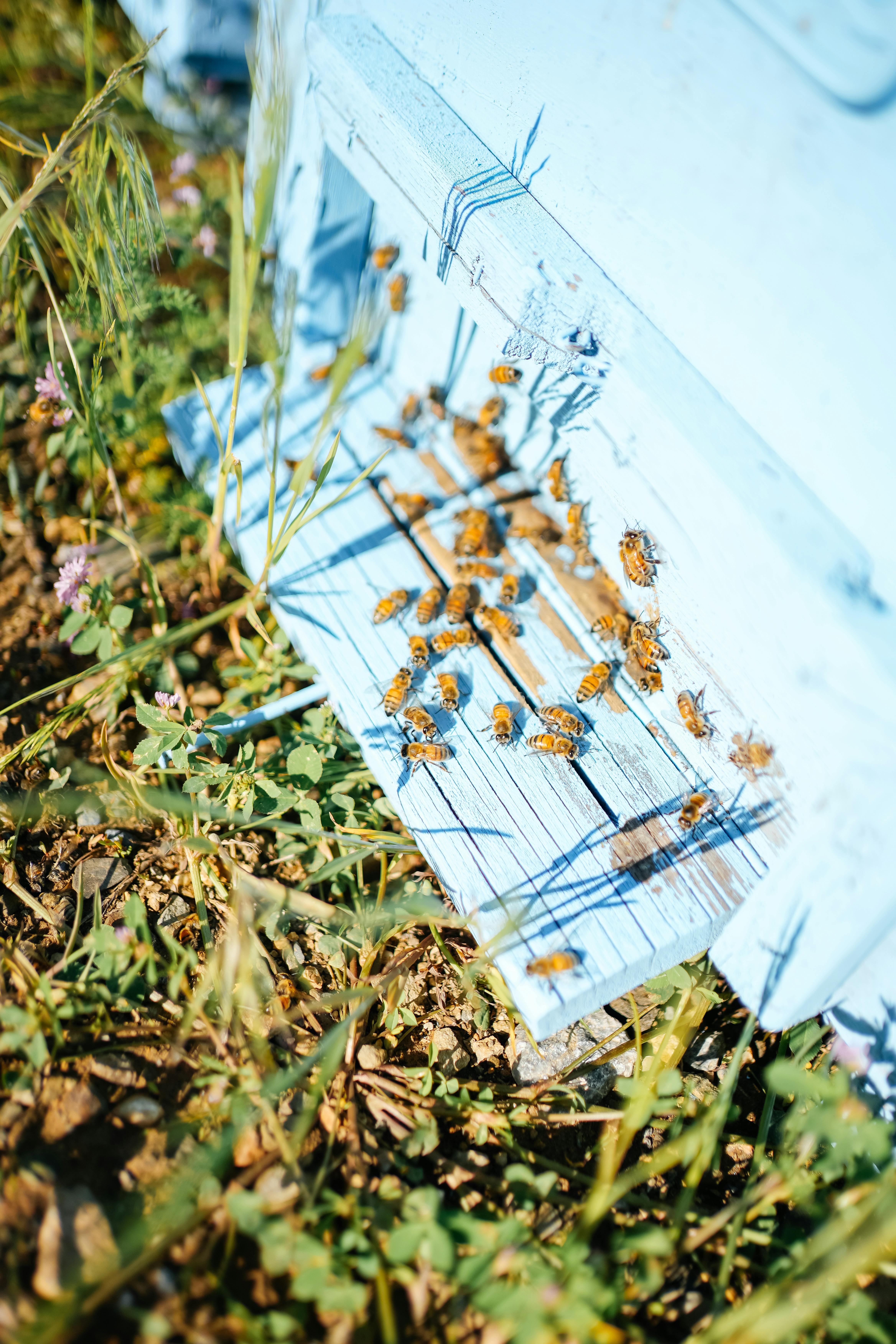
Pick up a jar of honey and consider this: to fill it, bees visited roughly two million flowers. Each one of those visits required a bee to fly out from the hive, navigate to the flower, collect a tiny load of nectar, and find her way home. Sometimes that round trip covered less than a mile. Sometimes it covered five.
Quick answer: Forager bees typically fly within one to two miles of the hive when food is available nearby. When local sources are scarce, they will travel up to five miles in a single trip. At peak foraging, one bee makes around ten trips per day and visits 50 to 100 flowers per trip. Over her lifetime, a single worker bee produces roughly 1/12 of a teaspoon of honey. To produce one pound, a colony collectively visits around two million flowers and flies an estimated 55,000 miles.
How far do bees actually fly from the hive?
The typical foraging range for a honeybee is one to two miles. That's the preference when food is close. If nectar sources within that range run thin, foragers will push further, sometimes three, four, or five miles from the hive in a single trip.
Five miles in every direction is a lot of ground. That radius covers a foraging territory of nearly 80 square miles radiating out from one hive. A bee flies at roughly 15 miles per hour unloaded, though she slows considerably on the return trip when she's carrying a full honey stomach.
Research from the University of Sussex has found that bees prefer to forage close to home when the option exists. Distance has real costs. The farther a bee flies, the more energy she burns and the longer each trip takes. A colony is running a tight efficiency calculation with thousands of foragers simultaneously, and short trips win when nature cooperates.
How do bees find flowers miles away and make it back?
Scout bees go first. Before the main foraging force leaves, experienced scouts fly out to locate nectar sources, then return to report what they found through the waggle dance, a precise physical language that encodes both direction and distance.
Direction is communicated as an angle relative to the sun. The duration of the waggle run tells other bees how far to fly. Karl von Frisch spent decades studying this behavior and was awarded the Nobel Prize in Physiology or Medicine in 1973 for decoding it. The waggle dance is one of the most sophisticated non-human communication systems ever documented. There is more on how the waggle dance works if you want to go deeper on that.
Once out in the field, bees navigate using sun position, polarized light patterns, landmarks, and the Earth's magnetic field. They have an internal clock that compensates for the sun's movement across the sky, so a forager that left the hive at 9am and returns at 11am recalibrates her sense of direction automatically. Getting lost is genuinely rare for a healthy forager under normal conditions.
How many flowers does it take to fill a jar of honey?
The numbers are hard to believe until you sit with them.
A single forager visits 50 to 100 flowers per trip. She makes roughly ten trips a day. Each trip yields about 40 milligrams of nectar, a small fraction of a teaspoon. That nectar is mostly water, around 80 percent. Back at the hive, bees pass it from bee to bee, evaporating the moisture down below 20 percent, at which point it becomes shelf-stable honey and gets capped with beeswax. The full story of how bees make honey is worth reading on its own.
To produce one pound of honey, a colony collectively flies an estimated 55,000 miles and visits roughly two million flowers. A standard 12-ounce jar represents about 10,000 miles of flight and around 1.5 million flower visits. One worker bee, over her entire lifespan, produces about 1/12 of a teaspoon. A lifetime of work, a twelfth of a teaspoon. That is what goes into the jar.
What happens when bees can't find enough flowers nearby?
When nearby forage is scarce, a colony feels it fast. Less nectar coming in means less honey being stored, less food for winter, and a weaker colony heading into the cold months. A hive surrounded by lawn, pavement, or monoculture farmland struggles in ways that aren't always visible from the outside. The foragers still go out, but they return with less, travel further, and burn more energy doing it.
This is part of what drives colony stress in heavily developed or agricultural areas. It isn't only pesticides or disease, though those are real pressures. It's also the absence of diverse, flowering plants within a reasonable foraging range. A bee flying four miles each trip just to find nectar is working harder for a smaller return, and that toll adds up across a whole season.
Small plantings make a genuine difference. A patch of native wildflowers, a few fruit trees, or even a yard that tolerates dandelions can support foraging from multiple nearby hives. Dandelions in particular are one of the most valuable early-season pollen sources a bee can find, which is one reason beekeepers tend to have a soft spot for them. What's blooming within two miles of a hive shapes everything, including what the honey tastes like season to season.
Why does all of this matter for local honey?
When bees forage across the cranberry bogs and coastal meadows of South Coast Massachusetts, the honey they bring back is a record of what was blooming within a few miles. A jar of wildflower honey from this area isn't the same as wildflower honey from somewhere else. The nectar sources are different. The landscape is different. The taste reflects both.
This is what local honey actually means, not just that it was bottled nearby, but that the bees doing the work were living in and flying over a specific place. The flavor in the jar is inseparable from the flowers those bees visited, the distances they flew to find them, and the particular character of the land around the hives. That's what you're tasting.
Understanding the honeybee lifecycle adds another layer to this. The forager bee collecting nectar today is in the final weeks of her life. Her whole existence has been building toward this. There is no more direct connection between a living thing and the food it produces.
Frequently Asked Questions
How many miles does a forager bee fly in a single day?
A busy forager makes roughly ten round trips per day during peak season. If her foraging site is one mile out, that's about 20 miles of flying per day. If she's traveling two to three miles each way, her daily mileage climbs to 40 or 50 miles. Over her foraging lifespan of roughly three weeks, she may cover 500 miles or more in total.
Can bees fly in cold weather or rain?
Bees need temperatures above about 50°F (10°C) to fly safely, and they avoid rain when possible. Cold rain is particularly dangerous because a wet bee loses heat rapidly and may not make it back to the hive. On overcast days, bees will often wait at the entrance for conditions to improve before heading out. Foraging tends to peak on warm, sunny mornings.
Do all bees in a colony forage?
No. Only about a third of a colony's population is foraging at any given time, and only older worker bees forage at all. Younger workers spend the first three weeks of their lives inside the hive doing other jobs: tending brood, building comb, processing nectar, guarding the entrance. Foraging is the final job of a worker bee's life, which is part of why it's so hard on them.
How do bees know when to come back to the hive?
A forager returns when her honey stomach is full, roughly after 50 to 100 flower visits. She also monitors energy levels continuously. If she's burned more energy reaching a flower patch than she'll recoup from the nectar there, she'll abandon that site. Bees are constantly running cost-benefit calculations, and a site that's too far or too depleted gets dropped from the waggle dance recruiting cycle.
Does the distance bees travel affect the flavor of honey?
Indirectly, yes. The distance bees travel is largely determined by what's blooming nearby. When local wildflowers, fruit trees, and native plants are abundant, bees forage close and produce honey that reflects that specific local landscape. When they're forced to range further, the flavor profile shifts accordingly. This is part of why raw honey from local hives varies from season to season and place to place in ways that commercial honey simply doesn't.


.jpg)
.jpg)